
My First National Tournament and the Photo that Changed my Mindset

Updated: Apr 29

The NCAA Tournament. It’s something you grow up watching, where the games feel bigger, the moments feel heavier, and everything carries just a little more weight. It’s not just another game on the schedule anymore — it’s win or go home.

On March 29th and March 31st, 2024, that stage became real for me. I was asked by QBSN to cover the NCAA Regional in Providence, Rhode Island. Not a regular season game, not a conference matchup — the national tournament. The highest level of collegiate athletics I had ever stepped into with a camera in my hands, and the first time I covered something where every single moment truly meant everything.

Walking into Amica Mutual Pavilion, it felt different right away. You could feel it before the puck even dropped — the energy, the urgency, the understanding that nobody in that building wanted their season to end. It wasn’t just another crowd, it was fans who knew exactly what was on the line. And for me, it wasn’t just another game either. It was the first time I was trusted to capture a stage like this.
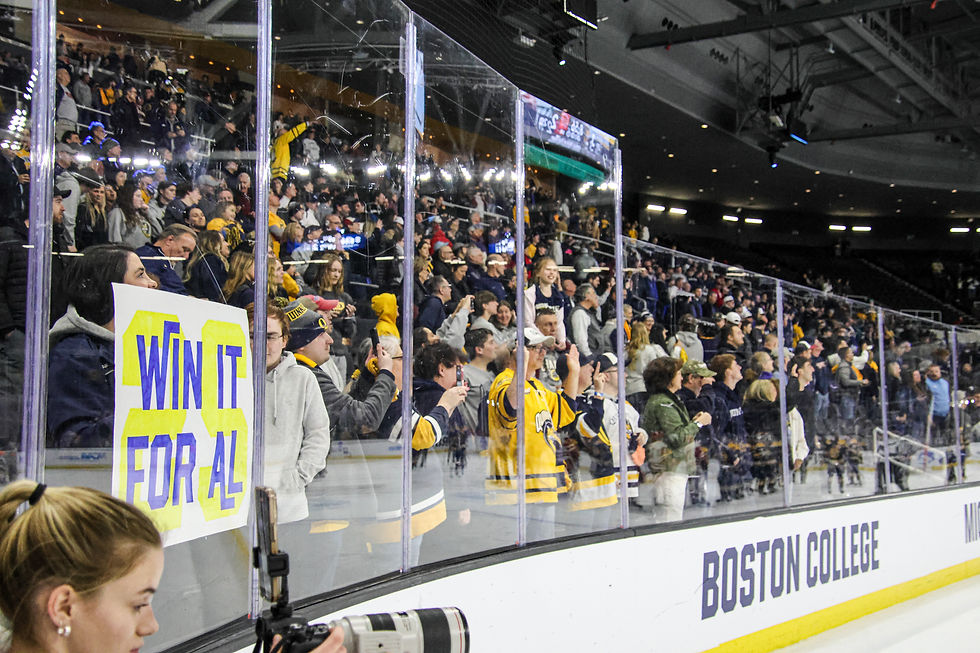
The regional semifinal against Wisconsin was chaos in the best way. Back-and-forth hockey, momentum swings, pressure on every shift. Quinnipiac jumped out early, Wisconsin answered, and suddenly it became the kind of game where you knew it wasn’t ending in regulation. Overtime in that environment is different — as a photographer, you know you only get one chance to capture that moment.

And then it happened. Victor Czerneckianar found the puck and buried the game-winner, sending Quinnipiac to the regional final. The bench emptied, the emotion took over, and it was one of those moments you don’t just watch — you feel it through the lens.
Two days later, it was a completely different kind of game. Same building, same stakes, but now it was Boston College — the No. 1 team in the country — with a trip to the Frozen Four on the line. And once again, it went to overtime. It felt like deja vu.

Quinnipiac fought for everything. Every puck battle, every zone entry, every defensive stand. They weren’t just playing a game — they were trying to extend their season, and their collegiate careers. But this time, it didn’t go their way. Boston College found the winner, and just like that, it was all over.
That was the part that hit the hardest. Not the goal, not the scoreboard, but what came after. The stillness. The realization that for some players, that was the last time they would ever step on the ice in a Quinnipiac jersey. The emotions you don’t see on the broadcast, the moments that don’t make the highlight reel — that’s what stayed with me.

Covering that weekend changed how I look at sports photography. At the national level, it’s not just about the big plays or the final score. It’s about understanding what those moments actually mean to the people in them. Every shot matters more, every reaction matters more, and every frame tells a story that goes beyond the scoreboard.

That was my first NCAA Tournament. The first time I covered a national stage, and the first time everything truly felt like it was on the line — not just for the players, but for me too. And it’s something I’ll never look at the same way again.

One photo from that weekend changed everything for me. After the Eagles turned on the goal horn in overtime, while Boston College celebrated in the distance, I turned and saw two Quinnipiac players kneeling on the ice — Lee and McGee — just watching it all unfold. The jumbotron above them read “Thank you for attending,” and it hit in a way I didn’t expect. Two players who were part of a national championship team the year before, now sitting there as their college careers came to an end. No helmets off, no dramatic reaction — just stillness. And in the background, the other team celebrating the moment they were chasing. That photo wasn’t about action, it wasn’t about the game-winning goal, it wasn’t even about the winning team. It was about the end of something. It was about contrast — celebration and heartbreak in the same frame. That was the moment I realized storytelling in sports photography isn’t always about what happens during the game, it’s about what happens after.


